


Spells are displays of magical prowess. The destructive arts of the black mage, the curative arts of the white mage, or the creature abilities of the blue mage. Unless otherwise noted, all spells have a somatic and verbal component. pathFinal Fantasy spellcasting is somewhat unique, though it borrows heavily from psionics, rather than traditional pathfinder spells, but is not exactly the same. As such, those who are familiar with the psionics system (Either the version published by Dreamscarred Press or the original version from D&D 3.5) will easily be able to adapt to this system.
One notable difference between pFF spellcasting and psionics, however, is that while pFF does include a psionic focus analogue, that is a specific class feature of some casters, not a core part of the system. This means that while class features or feats that require you to expend your Focus do exist, they are not needed for everything under the sun.
MP system
Spellcasters draw on a reserve of magical power known as Magic Points, or MP, to cast their spells, which allows them to manipulate powerful energies. These manipulations require natural talent and personal meditation. A spellcaster's level limits the number of MP available to cast spells. A spell caster’s key ability score might allow him to gain extra MP. He can cast the same spell more than once, but each spell cast subtracts MP from his daily limit. Casting a spell is an arduous mental task. To do so, a spell caster must have a key ability score of at least 10 + the spell’s effective level (See base cost of spells). To regain used daily MP, a spell caster must have a clear mind. To clear his mind, he must first rest for 8 hours. The character does not have to slumber for every minute of the time, but he must refrain from movement, combat, casting spells, skill use, conversation, or any other demanding physical or mental task during the rest period. If his rest is interrupted, each interruption adds 1 hour to the total amount of time he has to rest to clear his mind, and he must have at least 1 hour of rest immediately prior to regaining lost MP. If the character does not need to sleep for some reason, he still must have 8 hours of restful calm before regaining MP. If a spell caster has cast spells recently, the drain on his resources reduces his capacity to regain MP. When he regains MP for the coming day, all MP he has used within the last 8 hours count against his daily limit.
Peaceful Environment: To regain MP, a spell caster must have enough peace, quiet, and comfort to allow for proper concentration. The spell caster’s surroundings need not be luxurious, but they must be free from overt distractions, such as combat raging nearby or other loud noises. Exposure to inclement weather prevents the necessary concentration, as does any injury or failed saving throw the character might incur while concentrating on regaining MP.
Once the character has rested in a suitable environment, it takes only an act of concentration spanning 1 full round to regain all MP of the spell caster’s daily limit.
Death and MP: If a character dies, all daily MP stored is wiped away. A potent effect (such as arise) can recover the lost MP when it recovers the character.
Bonus MP: Characters gain bonus MP for having a high ability score. The ability score required is stated in each class. Determining how much bonus MP you get is actually a very simple calculation: Your key ability score modifier x your caster level x 0.5.
So, for example, a 10th level black mage with an intelligence score of 20 would gain 25 bonus MP. 5 (Mod) x 10 (Caster level) = 50. 50 x 0.5 (Or, 50/2, if you prefer) = 25.
Choosing A Spell
First you must choose which spell to cast. You can select any spell you know, provided you are capable of casting spells of that particular base cost. To cast a spell, you must pay MP, which counts against your daily total. You can cast the same spell multiple times if you have points left to pay for it.
Base Cost Of Spells
Spells in pathFinal Fantasy don’t actually have spell levels in the traditional sense. This is because many spells in pathFinal Fantasy can be “upgraded” on the fly via augmenting them (See augmentation). Instead, spells in pFF have a “base cost” that ranges from 1 to 20. Like augmenting a spell, you can’t cast a spell with a base cost higher than your caster level.
However, if you have an effect that would rely on you being able to cast a spell of a particular level, simply refer to the following table:| Base MP cost | Effective Spell Level |
| 1-2 | 1 |
| 3-4 | 2 |
| 5-6 | 3 |
| 7-8 | 4 |
| 9-10 | 5 |
| 11-12 | 6 |
| 13-14 | 7 |
| 15-16 | 8 |
| 17+ | 9 |
One more thing to note, when a base spell is “upgraded” via a passive augmentation the MP “cost” to upgrade that spell becomes its new base cost. For example, spending 5 MP on the Fire spell allows you to upgrade it to the Fira spell. Fira is considered to have a spell level of 3rd for effects that rely on it. However, spending 5 MP on the Fire spell but choosing to keep it as Fire means it retains its spell level of 1st.
This also applies when determining spells you “could” cast. For example, although Fire has a base cost of 1, and thus a spell level of 1, having a caster level of 5th means that you could, in theory, cast the fira spell, meaning effects that are based on you being able to cast 3rd level spells function for you even if you don’t otherwise have a base cost 5 spell.
This is known as a spell’s “Effective Spell Level” (Other variations, such as “The Spell’s Effective Level” are also used). While pFF generally has little use for traditional spell levels, this chart exists for the sake of backwards compatibility.
While the base cost for most spells is the same across all classes, sometimes a spell has a different base cost for a different class. This is noted on the base cost line and only applies to the spell in question. If a character can cast the same spell from different classes, he casts the cheapest version of the spell.
Components
All spells in pathFinal Fantasy have two components, the verbal, uttering words of power, and the somatic, mystical gestures to invoke the spell.
Verbal:
To provide a verbal component, you must be able to speak in a strong voice. A silence effect or a gag spoils the incantation (and thus the spell). a spellcaster who has been deafened has a 20% chance of spoiling any spell with a verbal component that he tries to cast.
Somatic:
A somatic component is a measured and precise movement of the hand. You must have at least one hand free to provide a somatic component.
Concentration
To cast a spell, you must concentrate. If something threatens to interrupt your concentration while you’re casting a spell, you must succeed on a concentration check or lose the MP without casting the spell. The more distracting the interruption and the higher the base cost of the spell that you are trying to cast, the higher the DC. (Costlier spells require more mental effort.) When you make a concentration check, you roll d20 and add your caster level and the ability score modifier used to determine bonus MP for that class. (Note: Although pFF doesn’t use spell levels per se, determining concentration DCs is one of the few places that framework is still used.)
Injury: Getting hurt or being affected by hostile spells while trying to cast a spell can break your concentration and ruin a spell. If you take damage while trying to cast a spell, you must make a concentration check (DC 10 + points of damage taken + the effective spell level). The interrupting event strikes during spell cast if it occurs between when you start and when you complete casting a spell (for a spell with a casting time of 1 round or longer) or if it comes in response to your casting the spell (such as an attack of opportunity provoked by the casting of the spellor a contingent attack from a readied action).
If you are taking continuous damage, half the damage is considered to take place while you are casting a spell. You must make a concentration check (DC 10 + 1/2 the damage that the continuous source last dealt + the effective spell level). If the last damage dealt was the last damage that the effect could deal then the damage is over, and it does not distract you.
Repeated damage does not count as continuous damage.
Spell: If you are affected by a spell while attempting to cast a spell of your own, you must make a concentration check or lose the spell you are casting. If the spell affecting you deals damage, the concentration DC is 10 + the damage taken + the effective level of the spellyou’re casting. If the spell interferes with you or distracts you in some other way, the concentration DC is the spell save DC + the level of the spellyou’re casting. For a spell with no saving throw, it’s the DC that the spell’s saving throw would have if a save were allowed (10 + the effective spell level + spellcaster’s ability modifier).
To cast a spell while grappling or pinned, you must make a concentration check (DC 10 + the grappler’s CMB + the level of the spellyou’re casting) or lose the spell.
If you are riding on a moving mount, taking a bouncy ride in a wagon, on a small boat in rough water, belowdecks in a storm-tossed ship, or simply being jostled in a similar fashion, you must make a concentration check (DC 10 + the level of the spellyou’re casting) or lose the spell.
If you are on a galloping horse, taking a very rough ride in a wagon, on a small boat in rapids or in a storm, on deck in a storm-tossed ship, or being tossed roughly about in a similar fashion, you must make a concentration check (DC 15 + the level of the spellyou’re casting) or lose the spell.
If you are in a high wind carrying blinding rain or sleet, the DC is 5 + the level of the spellyou’re casting. If you are in wind-driven hail, dust, or debris, the DC is 10 + the level of the spellyou’re casting. In either case, you lose the spell if you fail the concentration check. If the weather is caused by a spell, use the rules in the Spell subsection above.
If you want to cast a spell without provoking attacks of opportunity, you need to dodge and weave. You must make a concentration check (DC 15 + double the level of the spell you’re casting) to succeed. You lose the MP without a successful spell cast if you fail.
If you want to cast a spell while entangled in a net or while affected by a spell with similar effects you must make a DC 15 concentration check to cast the spell. You lose the spell if you fail.
Caster Level
The variables of a spell’s effect often depend on its caster level, which for most casting characters is equal to your class level. A spell that can be augmented for additional effect is also limited by your caster level (you can’t spend more MP on a spell at your caster level). See Augment under Descriptive Text, below.
You can cast a spell at a lower caster level than normal, but the caster level must be high enough for you to cast the spell in question, and all level-dependent features must be based on the same caster level.
In the event that a class feature or other special ability provides an adjustment to your caster level, this adjustment applies not only to all effects based on caster level (such as range, duration, and augmentation potential) but also to your caster level check to overcome your target’s spell resistance and to the caster level used in dispel checks (both the dispel check and the DC of the check).
Spell Failure
If you try to cast a spell in conditions where the characteristics of the spell (range, area, and so on) cannot be made to conform, the spell cast fails and the MP is wasted. spells also fail if your concentration is broken (see Concentration, above).
The Spell’s Result
Once you know which creatures (or objects or areas) are affected, and whether those creatures have made successful saving throws (if any were allowed), you can apply whatever results a spell entails.
Special Spell Effects
Certain special features apply to all spells.
Some spells refer to attacking. All offensive combat actions, even those that don’t damage opponents, such as disarm and bull rush, are considered attacks. Attempts to channel elements also count as attacks if it would harm any creatures in the area. All spells that opponents can resist with saving throws that deal damage, or that otherwise harm or hamper subjects are considered attacks. Astral construct and similar spells are not considered attacks because the spells themselves don’t harm anyone. Many spells give creatures bonuses to ability scores, Armor Class, attacks, and other attributes. Each bonus has a type that indicates how the spell grants the bonus. The important aspect of bonus types is that two bonuses of the same type don’t generally stack. With the exception of dodge bonuses, most circumstance bonuses, and racial bonuses, only the better bonus works. The same principle applies to penalties—a character taking two or more penalties of the same type applies only the worst one. Bonuses without a type always stack, unless they are from the same source.
Elemental Damage
Magic damage is almost always associated with an element.
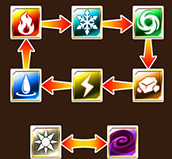
There are two categories of elements: Primary Elements and Secondary Elements.
Primary Elements are the more traditional Fire, Ice, Lightning, etc. The common damage types seen throughout the series.
General rule of the primary elements is this: Fire is strong against ice, ice is strong against wind, wind is strong against earth, earth is strong against lightning, lightning is strong against water and water is strong against fire.
Reversing this "wheel" means that fire is weak to water, water is weak to lightning, lightning is weak to earth, earth is weak to wind, wind is weak to ice and ice is weat to fire.
Dark and holy are both strong against each other and weak against each other.
See this image for a better understanding:
Secondary elements, which includes things like poison or sonic, are a little different, primarily because they aren’t technically elements, but they otherwise function similarly. For example, a creature can be weak to poison damage just as easily as it can be weak to fire damage. Whenever “elemental” damage (or things like “all elements”) is referenced, it only refers to the eight primary elements. Secondary elements are never included under the “elemental” banner. Whenever an effect would apply to secondary elements, it will explicitly state so.
Unlike the primary elements, the secondary elements are not strong or weak against one another. They simply exist. The following types of secondary elemental damage are:
Poison: Poison damage represents damage in the form of decay or other sorts of biological disruption. The poison status effect deals poison damage. Creatures that are specifically immune to poisons or the poison status effect are also immune to poison damage and vice versa, as poison damage and actual poisons are simply two different ways to mechanically represent the same base effect.
Sonic: Sonic damage is effectively “lesser” non-elemental damage (See below), though creatures can interact with sonic damage, unlike non-elemental. Sonic damage is unique in that it cannot affect creatures within an area of magical silence.
There is also a third type of damage: Non-Elemental. Non-elemental damage is equivalent to force damage and nothing can be strong or weak against it nor can you swap to it if an ability or class feature would allow you to swap elements. Non-elemental does not ignore hardness and is treated as an energy source.
Damage Interactions
Some creatures take more or less damage from particular sources. This is generically known as a creature’s “interaction” with damage. There are four types of interaction: Weak, Strong, Immune and Absorb. Elemental Resistance (The numbered kind standard to PF), though not an interaction, is also included here.
Weakness
If a creature is struck by elemental damage of an element it is weak to, it takes 1.5x the normal damage. When a spell of the appropriate element is cast upon the creature and forces a saving throw, the creature suffers a -2 penalty on the saving throw. A spellcaster casting a spell of an element that a creature with elemental resistance is weak to, he gets a +2 bonus on his caster level check.
Strong
If a creature is struck by elemental damage it is resistant to, it instead takes half that much damage (rounded down, minimum 1). Creatures get a +2 bonus to saving throws against spells of an element they are resistant to.
Immune
Some creatures are immune to specific elements. All spells of the chosen element have no effect whatsoever on a creature immune to that element.
Absorption
Some creatures are healed by damage of a particular element. For example, the undead are healed by dark damage. In this case, they are immune to non-damaging effects of spells of the appropriate element, and are instead healed when a spell of the element would normally deal damage (for an equal amount). If a creature has absorption to an element disregard any resistance to the same element.
Elemental resistance
Different from spell resistance, elemental resistance reduces damage by the number and element the creature has. For example, if a creature with 5 Elemental (Fire) resistance was struck by a Fire spell for 8 points of fire damage, the creature would only take 3 points of fire damage.
Other Interactions
Elemental damage is not the only interaction that exists, though it is by far the most common, with a creature’s interaction with status effects being a close second.
Physical Damage
Like elemental damage, creatures can interact with physical damage in exactly the same way.
A creature that is strong against physical damage only takes half as much damage (rounded down) from the attack. Merely being strong against physical damage does not give you an AC bonus, however.
Creatures weak to physical damage takes a -4 penalty to AC against physically damaging attacks. Creatures natively weak to physical damage almost never possess damage reduction.
Critical Hits
A creature that is weak to critical hits functions a little differently. In addition to taking 50% extra damage from the attack, a creature weak to critical hits must make a Fortitude save (DC equal to 10 + the attack’s attack bonus) or be stunned for one round. If it makes the save, it is instead staggered. This effect occurs even if the creature is otherwise immune to Fortitude-based effects, or the stunned/staggered conditions.
A creature that is strong against critical hits, however, functions in the same way as a creature strong against physical damage, taking only half of the bonus damage from the critical hit. Critical hits by abilities that deal ability score damage/ability score drain are not halved, however.
A creature that is both strong against critical hits and another source of damage only uses the "bigger" interaction. (For example, a creature with Strong: Critical Hits gains the Protected status effect and is then subject to a critical hit. All the damage is reduced by half, the creature doesn't take one quarter damage from the critical hit.)
Status Effects
Though not a damage type, some creatures can interact with status effects in much the same way, except that a creature cannot “absorb” status effects (With the exception of poison, due to also being a damage type.). They can interact with specific status effects or status effects in general. As per usual, specific trumps general, so a creature’s interaction with a specific status effect trumps any general interactions they have.
A creature that is weak to status effects is always afflicted with that effect, regardless of their saving throw result, unless a natural 20 is rolled.
A creature that is strong against status effects, however, receives a +5 bonus on its saving throw against that effect and a natural 1 is not an automatic failure. Additionally, the duration of the status effect is halved. If this would reduce the duration to less than 1 round, then the status effect never occurs at all.
One thing to note, a creature’s status effect interaction only applies to harmful status effects, unless otherwise noted. So, for example, a creature with Immune: Status Effects, can still benefit from Haste or Protect.
Creatures that are strong or immune to status effects in general are still vulnerable to poison damage. Only specifically being strong or immune to poison grants affects the damage type. Similarly, creatures that are weak to poison but strong or immune against status effects in general have the normal "stacking" effect against the status effect. (So, a creature weak to poison but strong against status effects has a normal interaction with the poison status effect, while a creature immune to status effects and weak to poison has a strong interaction against the status effect.)
Physical Damage From a Spell Source
While most spells deal elemental damage, there are some spells that deal physical damage. These spells are affected by damage reduction much the same way a physical attack would be. There’s little difference “at the point of contact”, so to speak, between swinging a sword and conjuring a sword.
Whenever a spell simply deals “physical” damage without specifying a type (Such as Force), that damage is considered Slashing, Piercing and Bludgeoning damage, though all physical damage from a spell source is considered magic for the purposes of bypassing damage reduction (AKA: DR/Magic), as one might expect.
Additionally a creature’s interaction with magical damage (e.g, a creature with “Immune: Magic”) is ignored, even though the effect is magical in nature. Instead a creature’s interaction with physical damage is all that matters. Spell Resistance might still apply, however, likewise any creature that is immune to spells that offer spell resistance (Such as golems) are still immune to physically-damaging spells.
PhysElemental Damage
In addition to normal elemental damage, pFF has a subtype of elemental damage known as physElemental damage.
Whenever a weapon or effect deals physElemental damage, the damage is elemental damage of the associated type, so physFire damage would be Fire damage. Creatures can be weak, strong, immune or absorb physElemental damage like normal elemental damage. By default, a creature that is (for example) weak to fire damage is also weak to physFire damage, but this is not always the case, however this is the exception and will be listed as a separate weakness or resistance.
However, unlike normal elemental damage, elemental resistance (That is to say, numbered elemental resistances) do not apply to physElemental damage. However, there is a special type of damage reduction unique to physElemental Damage. Whenever a creature has “DR X/non physElement”, such as DR 5/non physIce, this means that only damage from that physElement, in this case physIce, will be reduced by the stated amount. That said, by default a creature that natively possesses a numbered elemental resistance usually gains an equal amount of DR/non physElement. (A creature with Fire resist 5 has DR 5/non physFire.), though there are situations where they do not. Effects that generate an elemental resistance, such as the Resist Elements spell, do not automatically provide DR vs physElements.
Like normal damage reduction, a creature can have DR that is only bypassed by physElemental damage. So, for example, a creature with DR 5/physFire would reduce all physical damage by 5 points, other than physFire damage.
It should be noted, however, that you can never bypass physElemental damage reduction simply via having a high enhancement bonus on a weapon. On the other hand, physElemental DR is still DR. So effects or abilities that allow you to reduce or automatically overcome damage reduction still function normally.
Other types of damage reduction (Such as DR/Silver or DR/-) also reduce physElemental damage. Though, like all types of damage reduction, only the highest value applies. A creature with DR 10/Silver and DR 5/physFire would reduce a non-silver physFire attack by 10 points.
A creature that is weak to the element takes a -4 penalty to AC against physElemental attacks. However, like with physical damage, a creature strong against an element does not gain bonus to AC against physElemental attacks.
Effects and abilities will always use the ‘phys’ prefix when referring to physElemental damage, such as physFire or physIce. If an element appears without the prefix, it is normal elemental damage. Only damage that explicitly uses the ‘phys’ prefix is physElemental damage, even if the effect would imply otherwise.
Though rare, some effects can also deal physElemental damage of a secondary element, but those are listed explicitly. If you can choose between different types of physElemental damage (Including when crafting a physElemental weapon), you may not choose a secondary element, unless some effect explicitly allows it.
While it shouldn’t need to be stated, there is no such thing as physNon-Elemental. That’s just normal physical damage.
Interaction Stacking
As mentioned before, a creature can interact with physical damage in addition to elemental damage. This also applies to physElemental damage. A creature weak to physical damage takes extra damage from a physElemental attack even if it is not otherwise weak to the element itself.
That said, things get a little strange when a creature has both elemental and physical interactions. A creature that is weak or strong against both elemental and physical damage is quite simple, either they take twice the amount of damage (If weak to both) or only one quarter of the damage (If strong against both).
A creature weak to elemental damage but strong against physical damage (or vice versa) instead takes normal damage from a physElemental attack, as the weakness and resistance effectively cancel each other out.
However, if a creature is Immune to or Absorbs either physical or elemental damage, the creature’s immunity/absorption takes precedence, regardless of the other half. For example, a creature that is immune to physical damage but weak to fire damage is immune to physFire damage. If a creature Absorbs one half and is Immune to the other, absorption takes precedence.
Casting and Augmenting
If you take no other rule out of this segment, it is critical to remember that a spellcaster may not spend more MP on a spell at his caster level. This includes spending MP augmenting the spell, using metamagic feats, or effects that result in needing to pay an increased MP cost to cast a spell. For example a 5th level spellcaster may only spend a total of 5 MP on any single spell, while a 19th level may only spend a total of 19 MP on any single spell.
Effects that allow a spellcaster to increase this effect do so by increasing the spellcaster’s effective caster level – they are still bound by this rule.
Casting Time
Most spells have a casting time of 1 standard action. Others take 1 round or more, while a few require only a free action.
A spell that takes 1 round to cast requires a full-round action. It comes into effect just before the beginning of your turn in the round after you began casting the spell. You then act normally after the spell is completed. A spell that takes 1 minute to cast comes into effect just before your turn 1 minute later (and for each of those 10 rounds, you are casting a spell as a full-round action, as noted above for 1-round casting times). These actions must be consecutive and uninterrupted, or the spell points are lost and the spell fails.
When you use a spell that takes 1 round or longer to cast, you must continue the concentration from the current round to just before your turn in the next round (at least). If you lose concentration before the casting time is complete, the spell points are lost and the spell fails.
You make all pertinent decisions about a spell (range, target, area, effect, version, and so forth) when the spell comes into effect.
Range
A spell’s range indicates how far from you it can reach, as defined in the Range entry of the spell description. A spell’s range is the maximum distance from you that the spell’s effect can occur, as well as the maximum distance at which you can designate the spell’s point of origin. If any portion of the area would extend beyond the range, that area is wasted. Standard ranges include the following.
Personal: The spell affects only you.
Touch: You must touch a creature or object to affect it. A touch spell that deals damage can score a critical hit just as a weapon can. A touch spell threatens a critical hit on a natural roll of 20 and deals double damage on a successful critical hit. Some touch spells allow you to touch multiple targets. You can touch as many willing targets as you can reach, but all targets of the spell must be touched in the same round that you cast the spell.
Close: The spell reaches as far as 25 feet away from you. The maximum range increases 5 feet for every two caster levels you have.
Medium: The spell reaches as far as 100 feet + 10 feet per caster level.
Long: The spell reaches as far as 400 feet + 40 feet per caster level.
Range Expressed in Feet: Some spells have no standard range category, just a range expressed in feet.
Aiming A Spell
You must make some choice about whom the spell is to affect or where the spell’s effect is to originate, depending on the type of spell. The next entry in a spell description defines the spell’s target (or targets), its effect, or its area, as appropriate.
Target or Targets: Some spells have a target or targets. You cast these spells on creatures or objects, as defined by the spell itself. You must be able to see or touch the target, and you must specifically choose that target. However, you do not have to select your target until you finish casting the spell.
If you cast a targeted spell on the wrong type of target the spell has no effect. If the target of a spell is yourself (the spell description has a line that reads “Target: You”), you do not receive a saving throw and spell resistance does not apply. The Saving Throw and Spell Resistance lines are omitted from such spells.
Some spells can be casted only on willing targets. Declaring yourself as a willing target is something that can be done at any time (even if you’re flat-footed or it isn’t your turn). Unconscious creatures are automatically considered willing, but a character who is conscious but immobile or helpless (such as one who is bound, cowering, grappling, paralyzed, pinned, or stunned) is not automatically willing. The Saving Throw and Spell Resistance lines are usually omitted from such spells, since only willing subjects can be targeted.
Effect: Some spells, such as most metacreativity spells, create things rather than affect things that are already present. Unless otherwise noted in the spell description, you must designate the location where these things are to appear, either by seeing it or defining it. Range determines how far away an effect can appear, but if the effect is mobile, it can move regardless of the spell’s range once created.
Ray: Some effects are rays. You aim a ray as if using a ranged weapon, though typically you make a ranged touch attack rather than a normal ranged attack. As with a ranged weapon, you can fire into the dark or at an invisible creature and hope you hit something. You don’t have to see the creature you’re trying to hit, as you do with a targeted spell. Intervening creatures and obstacles, however, can block your line of sight or provide cover for the creature you’re aiming at.
If a ray spell has a duration, it’s the duration of the effect that the ray causes, not the length of time the ray itself persists.
If a ray spell deals damage, you can score a critical hit just as if it were a weapon. A ray spell threatens a critical hit on a natural roll of 20 and deals double damage on a successful critical hit.
Spread: Some effects spread out from a point of origin (which may be a grid intersection, or may be the caster) to a distance described in the spell. The effect can extend around corners and into areas that you can’t see. Figure distance by actual distance traveled, taking into account turns the effect may take. When determining distance for spread effects, count around walls, not through them. As with movement, do not trace diagonals across corners. You must designate the point of origin for such an effect (unless the effect is centered on you), but you need not have a line of effect (see below) to all portions of the effect.
(S) Shapeable: If an Effect line ends with “(S)” you can shape the spell. A shaped effect can have no dimension smaller than 10 feet.
Area: Some spells affect an area. Sometimes a spell description specifies a specially defined area, but usually an area falls into one of the categories defined below. Regardless of the shape of the area, you select the point where the spell originates, but otherwise you usually don’t control which creatures or objects the spell affects. The point of origin of a spell that affects an area is always a grid intersection. When determining whether a given creature is within the area of a spell, count out the distance from the point of origin in squares just as you do when moving a character or when determining the range for a ranged attack. The only difference is that instead of counting from the center of one square to the center of the next, you count from intersection to intersection.
You can count diagonally across a square, but every second diagonal counts as 2 squares of distance. If the far edge of a square is within the spell’s area, anything within that square is within the spell’s area. If the spell’s area touches only the near edge of a square, however, anything within that square is unaffected by the spell.
Burst, Emanation, or Spread: Most spells that affect an area function as a burst, an emanation, or a spread. In each case, you select the spell’s point of origin and measure its effect from that point. A burst spell affects whatever it catches in its area, even including creatures that you can’t see. It can’t affect creatures with total cover from its point of origin (in other words, its effects don’t extend around corners). The default shape for a burst effect is a sphere, but some burst spells are specifically described as cone-shaped.
A burst’s area defines how far from the point of origin the spell’s effect extends.
An emanation spell functions like a burst spell, except that the effect continues to radiate from the point of origin for the duration of the spell.
A spread spell spreads out like a burst but can turn corners. You select the point of origin, and the spell spreads out a given distance in all directions. Figure the area the spell effect fills by taking into account any turns the effect takes.
Cone, Line, or Sphere: Most spells that affect an area have a particular shape, such as a cone, line, or sphere. A cone-shaped spell shoots away from you in a quarter-circle in the direction you designate. It starts from any corner of your square and widens out as it goes. Most cones are either bursts or emanations (see above), and thus won’t go around corners.
A line-shaped spell shoots away from you in a line in the direction you designate. It starts from any corner of your square and extends to the limit of its range or until it strikes a barrier that blocks the line of effect. A line-shaped spell affects all creatures in squares that the line passes through or touches.
A sphere-shaped spell expands from its point of origin to fill a spherical area. Spheres may be bursts, emanations, or spreads.
Other: A spell can have a unique area, as defined in its description.
Line of Effect: A line of effect is a straight, unblocked path that indicates what a spell can affect. A solid barrier cancels a line of effect, but it is not blocked by fog, darkness, and other factors that limit normal sight. You must have a clear line of effect to any target that you cast a spell on or to any space in which you wish to create an effect. You must have a clear line of effect to the point of origin of any spell you cast.
A burst, cone, or emanation spell affects only an area, creatures, or objects to which it has a line of effect from its origin (a spherical burst’s center point, a cone-shaped burst’s starting point, or an emanation’s point of origin). An otherwise solid barrier with a hole of at least 1 square foot through it does not block a spell’s line of effect. Such an opening means that the 5-foot length of wall containing the hole is no longer considered a barrier for the purpose of determining a spell’s line of effect.
Duration
A spell’s Duration line tells you how long the magic energy of the spell lasts.
Timed Duration: Many durations are measured in rounds, minutes, hours, or some other increment. When the time is up, the magic energy sustaining the effect fades, and the spell ends. If a spell’s duration is variable it is rolled secretly.
Instantaneous: The magic energy comes and goes the instant the spell is casted, though the consequences might be long-lasting.
Permanent: The energy remains as long as the effect does. This means the spell is vulnerable to dispel magic.
Concentration: The spell lasts as long as you concentrate on it. Concentrating to maintain a spell is a standard action that does not provoke attacks of opportunity. Anything that could break your concentration when casting a spell can also break your concentration while you’re maintaining one, causing the spell to end. You can’t cast a spell while concentrating on another one. Some spells may last for a short time after you cease concentrating. In such a case, the spell keeps going for the given length of time after you stop concentrating, but no longer. Otherwise, you must concentrate to maintain the spell, but you can’t maintain it for more than a stated duration in any event. If a target moves out of range, the spell reacts as if your concentration had been broken.
Subject, Effects, and Area: If the spell affects creatures directly the result travels with the subjects for the spell’s duration. If the spell creates an effect, the effect lasts for the duration. The effect might move or remain still. Such an effect can be destroyed prior to when its duration ends. If the spell affects an area then the spell stays with that area for its duration. Creatures become subject to the spell when they enter the area and are no longer subject to it when they leave.
Touch spells and Holding the Charge: In most cases, if you don’t discharge a touch spell on the round you cast it, you can hold the charge (postpone the discharge of the spell) indefinitely. You can make touch attacks round after round. If you touch anything with your hand while holding a charge, the spell discharges. If you cast another spell, the touch spell dissipates.
Some touch spells allow you to touch multiple targets as part of the spell. You can’t hold the charge of such a spell; you must touch all the targets of the spell in the same round that you finish casting the spell. You can touch one friend (or yourself) as a standard action or as many as six friends as a full-round action.
Discharged: Occasionally a spell lasts for a set duration or until triggered or discharged.
(D) Dismissible: If the Duration line ends with “(D),” you can dismiss the spell at will. You must be within range of the spell’s effect and must mentally will the dismissal, which causes the same display as when you first casted the spell. Dismissing a spell is a standard action that does not provoke attacks of opportunity. A spell that depends on concentration is dismissible by its very nature, and dismissing it does not take an action or cause a display, since all you have to do to end the spell is to stop concentrating on your turn.
Saving Throw
Usually a harmful spell allows a target to make a saving throw to avoid some or all of the effect. The Saving Throw line in a spell description defines which type of saving throw the spell allows and describes how saving throws against the spell work.
Negates: The spell has no effect on a subject that makes a successful saving throw.
Partial: The spell causes an effect on its subject, such as death. A successful saving throw means that some lesser effect occurs (such as being dealt damage rather than being killed).
Half: The spell deals damage, and a successful saving throw halves the damage taken (round down).
None: No saving throw is allowed.
(object): The spell can be cast on objects, which receive saving throws only if they are magic or if they are attended (held, worn, grasped, or the like) by a creature resisting the spell, in which case the object uses the creature’s saving throw bonus unless its own bonus is greater. (This notation does not mean that a spell can be cast only on objects. Some spells of this sort can be cast on creatures or objects.) A magic item’s saving throw bonuses are each equal to 2 + one-half the item’s caster level.
(harmless): The spell is usually beneficial, not harmful, but a targeted creature can attempt a saving throw if it desires.
Saving Throw Difficulty Class: A saving throw against your spell has a DC of 10 + your key ability modifier + half the MP spent, rounded up.
Succeeding on a Saving Throw: A creature that successfully saves against a spell that has no obvious physical effects feels a hostile force or a tingle, but cannot deduce the exact nature of the attack. Likewise, if a creature’s saving throw succeeds against a targeted spell you sense that the spell has failed. You do not sense when creatures succeed on saves against effect and area spells.
Failing a Saving Throw against Mind-Affecting Spells: If you fail your save, you are unaware that you have been affected by a spell.
Automatic Failures and Successes: A natural 1 (the d20 comes up 1) on a saving throw is always a failure, and the spell may deal damage to exposed items (see Items Surviving after a Saving Throw, below). A natural 20 (the d20 comes up 20) is always a success.
Voluntarily Giving up a Saving Throw: A creature can voluntarily forego a saving throw and willingly accept a spell’s result. Even a character with a special resistance to magics can suppress this quality.
Items Surviving after a Saving Throw: Unless the descriptive text for the spell specifies otherwise, all items carried or worn by a creature are assumed to survive a magic attack. If a creature rolls a natural 1 on its saving throw against the effect, however, an exposed item is harmed (if the attack can harm objects). Refer to Table: Items Affected by Magic Attacks.
Determine which four objects carried or worn by the creature are most likely to be affected and roll randomly among them. The randomly determined item must make a saving throw against the attack form or take whatever damage the attack deals.
In order of most likely to least likely to be affected.
Table: Items Affected by Magic Attacks| Order | Item |
| 1st | Shield |
| 2nd | Armor |
| 3rd | Magic helmet, hat or headband |
| 4th | Item in hand (including weapon, wand or the like) |
| 5th | Magic cloak |
| 6th | Stowed or sheathed weapon |
| 7th | Magic bracers |
| 8th | Magic clothing |
| 9th | Magic jewelry (including rings) |
| 10th | Anything else |
Spell Resistance
Spell resistance is a special defensive ability. If your spell is being resisted by a creature with spell resistance, you must make a caster level check (d20 + caster level) at least equal to the creature’s spell resistance for the spell to affect that creature. The defender’s spell resistance functions like an Armor Class against magic attacks. Include any adjustments to your caster level on this caster level check.
The Spell Resistance line and the descriptive text of a spell description tell you whether spell resistance protects creatures from the spell. In many cases, spell resistance applies only when a resistant creature is targeted by the spell, not when a resistant creature encounters a spell that is already in place.
The terms “object” and “harmless” mean the same thing for spell resistance as they do for saving throws. A creature with spell resistance must voluntarily lower the resistance (a standard action) to be affected by a spell noted as harmless. In such a case, you do not need to make the caster level check described above.
Base Cost
All spells have a base cost line, indicating the minimum amount of MP that must be spent to cast that spell. A spell can have a base cost ranging from 1 to 20.
Most spells allow you to spend more than their base cost to achieve an improved effect, or augment the spell. The maximum number of points you can spend on a spell (for any reason) is equal to your caster level.
Some spells have a base cost of 0. These spells are known as “Cantrips” and can be used at-will. (See Cantrips for more details).
Descriptive Text
This portion of a spell description details what the spell does and how it works. If one of the previous lines in the description included “see text,” this is where the explanation is found. If the spell you’re reading about is based on another spell you might have to refer to a different spell for the “see text” information.
Active Augment: Many spells have variable effects based on the number of spell points you spend when you cast them. The more points spent, the more powerful the castation. How this extra expenditure affects a spell is specific to the spell. Some augmentations allow you to increase the number of damage dice, while others extend a spell’s duration or modify a spell in unique ways. Each spell that can be augmented includes an entry giving how many spell points it costs to augment and the effects of doing so. However, you can spend only a total number of points on a spell equal to your caster level.
Augmenting a spell takes place as part of another action (casting a spell). Unless otherwise noted in the Augment section of an individual spell description, you can augment a spell only at the time you cast it.
Passive Augment: In addition to the regular augment effects, some spells also have a passive augmentation ability, often upgrading the spell into a more powerful effect, such as changing a single-target spell into an area of effect, or allowing a resurrection spell to restore a creature more fully. A passive augmentation does not “cost” MP, rather when you spend a certain amount of MP on an active augment, you can choose to also make use of a passive augment.
Some spells have multiple passive augments, representing different spells. Unless a “more expensive” augment overwrites it, you gain all the benefits of a spell’s passive augmentations that you choose to make use of.
For example, one spell’s passive augmentations might all change a spell’s effect (Turning a Ray into a Cone, for example), but only one passive augmentation might change the dice rolled. In this case, going to later “tiers” of the passive augmentation would change the effect again, but because those later tiers don't affect the dice rolled, you use the “earlier” augmentation for that. Most commonly, however, is one early augmentation gives the spell a saving throw, which later augmentations continue to use unless overwritten.
Only MP spent on the active augmentation counts for this purpose. MP spent on Metamagic feats does not allow you to make use of a passive augment.
Spell-Like Abilities
Usually, a spell-like ability works just like the spell of that name. A spell-like ability has no verbal or somatic components, nor does it require any other components or focuses, even if the spell it's mimicking would. The user activates it mentally. Armor never affects a spell-like ability’s use, even if the ability resembles an arcane spell with a somatic component.
All creatures with spell-like abilities are assigned a caster level, which indicates how difficult it is to dispel their spell-like effects and determines all level-dependent variables (such as range or duration) the abilities might have. When a creature uses a spell-like ability, the power is cast as if the creature had spent an amount of MP equal to its caster level, which may augment the spell to improve its damage and determine the save DC. However, the creature does not actually spend power points for its spell-like abilities, even if it has an MP pool due to racial abilities, class levels, or some other ability.
A spell-like ability has a casting time of 1 standard action unless noted otherwise in the ability or spell description. In all other ways, a spell-like ability functions just like a spell. Unlike actual spells, a creature does not usually gain the ability to passively augment spells, even if they would have a high enough caster level to do so, instead they are assigned specific passive augmentations they can use, for example if only Fire is listed as a spell-like ability, the creature cannot use that spell-like ability to cast Fira, regardless of its caster level. Some abilities may allow a creature to ignore this restriction, however.
Spell-like abilities are subject to spell resistance and dispel magic. They do not function in areas where magic is suppressed or negated. Spell-like abilities cannot be used to counterspell, nor can they be counterspelled.
If a character class grants a spell-like ability that is not based on an actual spell, the ability’s effective spell level is equal to the highest-level class spell the character can cast, and is cast at the class level the ability is gained
