


While pathFinal Fantasy uses many of the standard pathfinder rules, there are a number of modifications to the combat rules either because of the elephant in the room system or because of mechanics unique to pathFinal Fantasy. The following rules catalogue those changes and anything not present here should be assumed to function as per standard pathfinder rules.
Combat Maneuvers and Options
Hamstring (New maneuver)
You can attempt to hamstring your opponent’s movement in place of a melee attack. You can only hamstring an opponent who is no more than one size category larger than you. If you do not have the Powerful Maneuvers feat, or a similar ability, initiating a hamstring provokes an attack of opportunity from the target of your maneuver. If your attack exceeds the target’s CMD, the target is entangled for 1 round. For every 5 by which your attack exceeds your opponent’s CMD, the penalty lasts 1 additional round. Creatures that are immune to critical hits - such as elementals and oozes - cannot be hamstrung. Flying creatures can be hamstrung, but only if they use non-magical means for flight (such as wings).
Throw (New maneuver)
You can attempt to throw an opponent as a standard action. You can only throw an opponent who is your size category or smaller. A throw attempts to grab an opponent and hurl them to a new location while you remain in your original position. If you do not have the unarmed combatant feat or a similar ability, attempting to throw a foe provokes an attack of opportunity. A throw can be used to move a creature into a space that is intrinsically dangerous. If you are the controller of a grapple, you gain a +5 bonus on this check when performing it on a grappled creature. A creature must have at least one appendage free (Such as a hand, tentacle, paw or something vaguely similar like a mouth) in order to throw an opponent.
If your attack is successful, your opponent is thrown 5ft in a direction of your choice. For every 5 by which your attack exceeds your opponent’s CMD, you can move the target an additional 5 feet. If you are larger than the target or the target moves at least 10ft horizontally as a result of this maneuver (Either due to beating their CMD by 5 or more or throwing them down a pit), the target is also knocked prone where they land. An opponent that is thrown in this way is thrown through the air off the ground a number of feet equal to your natural reach.
If you are throwing the target directly upwards, they instead move 5ft upwards, with an additional 2ft of vertical movement for every 5 by which the CMD is exceeded. This does not cause the target to be knocked prone unless the height of the throw is 10 feet or greater.
An enemy being moved by a throw does not provoke an attack of opportunity because of the movement unless you possess the Greater Throw feat.
Combat Maneuver Bonus
Each character and creature has a Combat Maneuver Bonus (or CMB) that represents its skill at performing combat maneuvers. A creature’s CMB is determined using the following formula:
CMB = Base attack bonus + Strength modifier (or Dexterity modifier, see below) + special size modifier
Dexterity Modifier
When wielding a light or finesse weapon (Unarmed strikes are light weapons, so having a free hand counts even if you do not have unarmed combatant), a character can use his Dexterity modifier to determine his combat maneuver bonus, rather than his strength modifier, when performing a disarm, dirty trick, reposition, steal or trip maneuver.
However, a character always uses their Strength modifier when performing a bull rush, drag, grapple, hamstring, overrun or throw maneuver, unless they possess the Agile Combatant feat.
Special Size Modifier
Creatures that are size Tiny or smaller use their Dexterity modifier in place of their Strength modifier to determine their CMB (Though they must still take Agile Maneuvers in order to qualify for other feats). The special size modifier for a creature’s Combat Maneuver Bonus is as follows:
Fine –8, Diminutive –4, Tiny –2, Small –1, Medium +0, Large +1, Huge +2, Gargantuan +4, Colossal +8.
Some feats and abilities grant a bonus to your CMB when performing specific maneuvers.
New Combat Options
While Power Attack, Deadly Aim and Combat Expertise have been removed as feats, Power Attack and Deadly Aim have been folded together into the new Power Attack combat option, while the benefits of Combat Expertise have been folded into the Fighting Defensively combat option. (Any character can perform a combat option, regardless of what feats they possess.)
Power Attack
Requirements: Base Attack Bonus +1
You can choose to take a –1 penalty on all attack rolls and combat maneuver checks to gain a +2 bonus on all damage rolls. This bonus to damage is increased by half (+50%) if you are making an attack with a two-handed weapon, a one handed weapon using two hands, or a primary natural weapon that adds 1-1/2 times your Strength modifier on damage rolls. This bonus to damage is halved (–50%) if you are making an attack with an off-hand weapon or secondary natural weapon.
When your base attack bonus reaches +4, and every 4 points thereafter, the penalty increases by –1 and the bonus to damage increases by +2.
You must choose to use power attack before making an attack roll, and its effects last until your next turn. The bonus damage does not apply to touch attacks or effects that do not deal hit point damage.
Fighting Defensively
When attacking as a standard or full-attack action, you may choose to take a -4 penalty on attack rolls and combat maneuver checks to gain a +2 dodge bonus to your AC. If you have a Base Attack Bonus of +1 or higher, you may choose to take a -1 penalty to gain a +1 dodge bonus to your AC. This can be used in addition to the normal effects of fighting defensively or instead of them.
When your base attack bonus reaches +4, and every 4 points thereafter, this additional penalty increases by -1 and the dodge bonus to AC increases by +1.
You must choose to fight defensively before making an attack roll, and its effects last until your next turn.
Elemental Damage
(The following information can also be found on the spellcasting page, but it is replicated here for ease of reference.)
Magic damage is almost always associated with an element.
There are two categories of elements: Primary Elements and Secondary Elements.
Primary Elements are the more traditional Fire, Ice, Lightning, etc. The common damage types seen throughout the series.
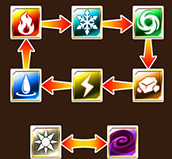
General rule of the primary elements is this: Fire is strong against ice, ice is strong against wind, wind is strong against earth, earth is strong against lightning, lightning is strong against water and water is strong against fire.
Reversing this "wheel" means that fire is weak to water, water is weak to lightning, lightning is weak to earth, earth is weak to wind, wind is weak to ice and ice is weat to fire.
Shadow and holy are both strong against each other and weak against each other.
See this image for a better understanding:
Secondary elements, which includes things like poison or sonic, are a little different, primarily because they aren’t technically elements, but they otherwise function similarly. For example, a creature can be weak to poison damage just as easily as it can be weak to fire damage. Whenever “elemental” damage (or things like “all elements”) is referenced, it only refers to the eight primary elements. Secondary elements are never included under the “elemental” banner. Whenever an effect would apply to secondary elements, it will explicitly state so.
Unlike the primary elements, the secondary elements are not strong or weak against one another. They simply exist. The following types of secondary elemental damage are:
Poison: Poison damage represents damage in the form of decay or other sorts of biological disruption. The poison status effect deals poison damage. Creatures that are immune to poisons or the poison status effect are also immune to poison damage and vice versa, as poison damage and actual poisons are simply two different ways to mechanically represent the same base effect.
Sonic: Sonic damage is effectively “lesser” non-elemental damage (See below), though creatures can interact with sonic damage, unlike non-elemental. Sonic damage is unique in that it cannot affect creatures within an area of magical silence.
There is also a third type of damage: Non-Elemental. Non-elemental damage is equivalent to force damage and nothing can be strong or weak against it nor can you swap to it if an ability or class feature would allow you to swap elements. Non-elemental does not ignore hardness and is treated as an energy source.
Damage Interactions
Some creatures take more or less damage from particular sources. This is generically known as a creature’s “interaction” with damage. There are four types of interaction: Weak, Strong, Immune and Absorb. Elemental Resistance (The numbered kind standard to PF), though not an interaction, is also included here.
Weakness
If a creature is struck by elemental damage of an element it is weak to, it takes 1.5x the normal damage. When a spell of the appropriate element is cast upon the creature and forces a saving throw, the creature suffers a -2 penalty on the saving throw. A spellcaster casting a spell of an element that a creature with elemental resistance is weak to, he gets a +2 bonus on his caster level check.
Strong
If a creature is struck by elemental damage it is resistant to, it instead takes half that much damage (rounded down, minimum 1). Creatures get a +2 bonus to saving throws against spells of an element they are resistant to.
Immune
Some creatures are immune to specific elements. All spells of the chosen element have no effect whatsoever on a creature immune to that element.
Absorption
Some creatures are healed by damage of a particular element. For example, the undead are healed by shadow damage. In this case, they are immune to non-damaging effects of spells of the appropriate element, and are instead healed when a spell of the element would normally deal damage (for an equal amount). If a creature has absorption to an element disregard any resistance to the same element.
Elemental resistance
Different from spell resistance, elemental resistance reduces damage by the number and element the creature has. For example, if a creature with 5 Fire resistance was struck by a Fire spell for 8 points of fire damage, the creature would only take 3 points of fire damage.
Other Interactions
Elemental damage is not the only interaction that exists, though it is by far the most common, with a creature’s interaction with status effects being a close second.
Physical Damage
Like elemental damage, creatures can interact with physical damage in exactly the same way.
A creature that is strong against physical damage only takes half as much damage (rounded down) from the attack. Merely being strong against physical damage does not give you an AC bonus, however.
Creatures weak to physical damage takes a -4 penalty to AC against physically damaging attacks. Creatures natively weak to physical damage almost never possess damage reduction.
Critical Hits
A creature that is weak to critical hits functions a little differently. In addition to taking 50% extra damage from the attack, a creature weak to critical hits must make a Fortitude save (DC equal to 10 + the attack’s attack bonus) or be stunned for one round. If it makes the save, it is instead staggered. This effect occurs even if the creature is otherwise immune to Fortitude-based effects, or the stunned/staggered conditions.
A creature that is strong against critical hits, however, functions in the same way as a creature strong against physical damage, taking only half of the bonus damage from the critical hit. Critical hits by abilities that deal ability score damage/ability score drain are not halved, however.
A creature that interacts with critical hits and another source of damage only uses the better interaction. (For example, a creature with Strong: Critical Hits gains the Protected status effect and is then subject to a critical hit. All the damage is reduced by half, the creature doesn't take one quarter damage from the critical hit.)
Status Effects
Though not a damage type, some creatures can interact with status effects in much the same way, except that a creature cannot “absorb” status effects (With the exception of poison, due to also being a damage type.). They can interact with specific status effects or status effects in general. As per usual, specific trumps general, so a creature’s interaction with a specific status effect trumps any general interactions they have.
A creature that is weak to status effects is always afflicted with that effect, regardless of their saving throw result, unless a natural 20 is rolled.
A creature that is strong against status effects, however, receives a +5 bonus on its saving throw against that effect and a natural 1 is not an automatic failure. Additionally, the duration of the status effect is halved. If this would reduce the duration to less than 1 round, then the status effect never occurs at all.
One thing to note, a creature’s status effect interaction only applies to harmful status effects, unless otherwise noted. So, for example, a creature with Immune: Status Effects, can still benefit from Haste or Protect.
Physical Damage From a Spell Source
While most spells deal elemental damage, there are some spells that deal physical damage. These spells are affected by damage reduction much the same way a physical attack would be. There’s little difference “at the point of contact”, so to speak, between swinging a sword and conjuring a sword.
Whenever a spell simply deals “physical” damage without specifying a type (Such as Force), that damage is considered Slashing, Piercing and Bludgeoning damage. This type of damage is considered magic for the purposes of bypassing damage reduction, as one might expect.
Additionally a creature’s interaction with magical damage (e.g, a creature with “Immune: Magic”) is ignored, even though the effect is magical in nature. Instead a creature’s interaction with physical damage is all that matters. Spell Resistance might still apply, however, likewise any creature that is immune to spells that offer spell resistance (Such as golems) are still immune to physically-damaging spells.
PhysElemental Damage
In addition to normal elemental damage, pFF has a subtype of elemental damage known as physElemental damage.
Whenever a weapon or effect deals physElemental damage, the damage is elemental damage of the associated type, so physFire damage would be Fire damage. Creatures can be weak, strong, immune or absorb physElemental damage like normal elemental damage. By default, a creature that is (for example) weak to fire damage is also weak to physFire damage, but this is not always the case, however this is the exception and will be listed as a separate weakness or resistance.
However, unlike normal elemental damage, elemental resistance (That is to say, numbered elemental resistances) do not apply to physElemental damage. However, there is a special type of damage reduction unique to physElemental Damage. Whenever a creature has “DR X/non physElement”, such as DR 5/non physIce, this means that only damage from that physElement, in this case physIce, will be reduced by the stated amount. That said, by default a creature that natively possesses a numbered elemental resistance usually gains an equal amount of DR/non physElement. (A creature with Fire resist 5 has DR 5/non physFire.), though there are situations where they do not. Effects that generate an elemental resistance, such as the Resist Elements spell, do not automatically provide DR vs physElements.
Like normal damage reduction, a creature can have DR that is only bypassed by physElemental damage. So, for example, a creature with DR 5/physFire would reduce all physical damage by 5 points, other than physFire damage.
It should be noted, however, that you can never bypass physElemental damage reduction simply via having a high enhancement bonus on a weapon. On the other hand, physElemental DR is still DR. So effects or abilities that allow you to reduce or automatically overcome damage reduction still function normally.
Other types of damage reduction (Such as DR/Silver or DR/-) also reduce physElemental damage. Though, like all types of damage reduction, only the highest value applies. A creature with DR 10/Silver and DR 5/physFire would reduce a non-silver physFire attack by 10 points.
A creature that is weak to the element takes a -4 penalty to AC against physElemental attacks. However, like with physical damage, a creature strong against an element does not gain bonus to AC against physElemental attacks.
Effects and abilities will always use the ‘phys’ prefix when referring to physElemental damage, such as physFire or physIce. If an element appears without the prefix, it is normal elemental damage. Only damage that explicitly uses the ‘phys’ prefix is physElemental damage, even if the effect would imply otherwise.
Though rare, some effects can also deal physElemental damage of a secondary element, but those are listed explicitly. If you can choose between different types of physElemental damage (Including when crafting a physElemental weapon), you may not choose a secondary element, unless some effect explicitly allows it.
While it shouldn’t need to be stated, there is no such thing as physNon-Elemental. That’s just normal physical damage.
Interaction Stacking
As mentioned before, a creature can interact with physical damage in addition to elemental damage. This also applies to physElemental damage. A creature weak to physical damage takes extra damage from a physElemental attack even if it is not otherwise weak to the element itself.
That said, things get a little strange when a creature has both elemental and physical interactions. A creature that is weak or strong against both elemental and physical damage is quite simple, either they take twice the amount of damage (If weak to both) or only one quarter of the damage (If strong against both).
A creature weak to elemental damage but strong against physical damage (or vice versa) instead takes normal damage from a physElemental attack, as the weakness and resistance effectively cancel each other out.
However, if a creature is Immune to or Absorbs either physical or elemental damage, the creature’s immunity/absorption takes precedence, regardless of the other half. For example, a creature that is immune to physical damage but weak to fire damage is immune to physFire damage. If a creature Absorbs one half and is Immune to the other, absorption takes precedence.
Guard
Guard is a mechanic unique to pathFinal Fantasy. Guard represents a character's ability to withstand damage, either through sheer determination, magical defenses or just mere durability.
Guard Basics
Guard is measured in charges, or points, similar to HP. A character can only hold a certain amount of Guard. Unless otherwise stated, a character can only hold 1 point of Guard + 1 point of Guard per four hit dice they have. However, some abilities may modify or override this restriction. For example while a character can have only one instance of each nul-element spell active at once, they can benefit from all nul-element spells simultaniously, regardless of their hit dice. (It shouldn't need to be said, but this is an effect of the spells themselves, not a core rule of Guard).
Whenever a character with Guard would take damage, the damage is negated entirely and they instead lose one Guard. The amount of damage is irrelevant, taking one point of damage breaks a Guard just as easily as taking one hundred points. Characters are still considered to have been struck by the attack, it merely dealt no damage. Similar to how damage reduction functions.
Guard abilities always take precedence over Interaction. So, a monster that would Absorb fire damage has a Guard, they would take no damage from a fire-based attack, rather than absorbing it.
Guard Types
Some guard abilities dictate what types of damage they protect against. So a Physical Guard to protect against physical damage, or a Fire Guard to protect against fire damage. A Guard makes no distinction between elemental damage and physElemental damage. So, a Fire Guard would protect against a Firaga just as it would against an Enstrike.
If a character would just gain a Guard without a prefix, then that Guard simply protects against the next source of incoming damage.
Weapons
Light and Finesse Weapon special rules
pFF does not have a Weapon Finesse feat. Instead, any character using a Light or Finesse weapon may use their Dexterity modifier, in place of strength, to determine their Attack modifier when using that weapon.
Weapon Groups
Looking over the Warrior class, you'll notice quite quickly that only Melee weapon groups are actually referenced on Warrior. It should be noted, however, that this is just a design choice of that class. All of the normal pathfinder weapon groups are available. Though, for posterity here is the full list (Or, at least, the fullest list that we know of. Some weapons may be missing from this list. When in doubt, if a weapon says its a part of a weapon group, it's a part of that weapon group.):
Axes: Bardiche, battleaxe, boarding axe, collapsible kumade, dwarven double waraxe, dwarven longaxe, dwarven maulaxe, dwarven waraxe, gandasa, greataxe, handaxe, heavy pick, hooked axe, hurlbat, knuckle axe, kumade, light pick, mattock, orc double axe, pata, throwing axe, and tongi
Blades, Heavy: Aldori dueling sword, ankus, bastard sword, chakram, cutlass, double chicken saber, double walking stick katana, elven curve blade, estoc, falcata, falchion, flambard, great terbutje, greatsword, katana, khopesh, longsword, nine-ring broadsword, nodachi, rhoka sword, sawtooth sabre, scimitar, scythe, seven-branched sword, sharpened combat scabbard, shotel, switchscythe, temple sword, terbutje, and two-bladed sword
Blades, Light: Bayonet, blade boot, brass knife, butterfly sword, chakram, dagger, deer horn knife, dogslicer, gladius, hunga munga, kama, kerambit, kukri, kunai, machete, manople, pata, quadrens, rapier, ratfolk tailblade, sea-knife, short sword, sica, sickle, starknife, switchblade knife, sword cane, swordbreaker dagger, tailblade, wakizashi, and war razor
Bows: Composite longbow, composite shortbow, longbow, shortbow, and thorn bow
Close: Armor spikes, barbazu beard, bayonet, blade boot, brass knuckles, cestus, dan bong, dwarven boulder helm, emei piercer, fighting fan, garrote, gauntlet, heavy shield, hook hand, iron brush, klar, light shield, madu, mere club, punching dagger, rope gauntlet, sap, scizore, shield spikes, spiked gauntlet, tekko-kagi, tonfa, unarmed strike, wooden stake, and wushu dart
Crossbows: Crank crossbow (heavy), crank crossbow (light), double crossbow, gastraphetes, hand crossbow, heavy crossbow, launching crossbow, light crossbow, repeating hand crossbow, repeating hand crossbow, repeating heavy crossbow, repeating light crossbow, slaver’s crossbow (heavy), slaver’s crossbow (light), stonebow, tube arrow shooter, underwater light crossbow, and underwater heavy crossbow
Double Weapons: Battle ladder, bo staff, boarding gaff, chain spear, dire flail, double walking stick katana, double-chained kama, dwarven double waraxe, dwarven urgrosh, gnome hooked hammer, halfling double sling, kusarigama, monk’s spade, orc double axe, quarterstaff, taiaha, two-bladed sword, and weighted spear
Firearms: All light*, one-handed, two-handed, and siege firearms
*pathFinal Fantasy firearms do not exist, yet, but they function somewhat differently. Including the fact that some are considered light weapons inherently.
Flails: Battle poi, bladed scarf, cat-o’-nine-tails, chain spear, dire flail, double chained kama, dwarven dorn-dergar, flail (light flail), flailpole, flickmace, flindbar, flying blade, gnome pincher, halfling rope-shot, heavy flail, kusarigama, kyoketsu shoge, meteor hammer, morningstar, nine-section whip, nunchaku, sansetsukon, scorpion whip, spiked chain, urumi, and whip
Hammers: Aklys, battle aspergillum, club, combat scabbard, dwarven longhammer, dwarven maulaxe, earth breaker, greatclub, hanbo, heavy mace, knobkerrie, light hammer, light mace, mere club, piston maul, planson, taiaha, tetsubo, wahaika, and warhammer
Kobold Tail Attachment: Long lash, pounder, razored tail attachment, spiked tail attachment, and sweeper
Monk: Bo staff, brass knuckles, butterfly sword, cestus, dan bong, deer horn knife, double chained kama, double chicken saber, emei piercer, fighting fan, hanbo, jutte, kama, kusarigama, kyoketsu shoge, lungchuan tamo, monk’s spade, nine-ring broadsword, nine-section whip, nunchaku, quarterstaff, rope dart, sai, sansetsukon, seven-branched sword, shang gou, shuriken, siangham, tiger fork, tonfa, tri-point double-edged sword, unarmed strike, urumi, and wushu dart
Natural: Unarmed strike and all natural weapons, such as bite, claw, gore, tail, and wing
Polearms: Bardiche, bec de corbin, bill, boarding gaff, crook, fauchard, flailpole, glaive, glaive-guisarme, guisarme, halberd, hooked lance, horsechopper, lucerne hammer, mancatcher, monk’s spade, ogre hook, naginata, nodachi, ranseur, ripsaw glaive, and tiger fork
Samurai*: Dagger, Fullblade, Hanbo, Katana, Katana (Double Walking Stick), Longspear, Naginata, Nodachi, Quarterstaff, Shortspear, Spear, Tetsubo, Wakizashi
*This weapon group is unique to pathFinal Fantasy.
Siege Weapons: Ballista, bombard, catapult, corvus, firedrake, firewyrm, gallery, ram, siege tower, springal, trebuchet, and all other siege engines (see Ultimate Combat for more details)
Spears: Amentum, barbed spear, boar spear, boarding pike, chain spear, doru, elven branched spear, flask pike, javelin, harpoon, injection spear, lance, longspear, orc skull ram, pilum, planson, sarissa, shortspear, sibat, spear, spear-sling, syringe spear, tiger fork, totem spear, trident, and weighted spear
Thrown: Aklys, amentum, atlatl, blowgun, bolas, boomerang, chakram, club, crystal chakram, dagger, dart, deer horn knife, dire bolas, doru, flask thrower, grappling hook, Halfling double sling, halfling sling staff, harpoon, hunga munga, hurlbat, javelin, jolting dart, lasso, kestros, knobkerrie, kunai, light hammer, net, phaleros, poisoned sand tube, rope dart, shortspear, shrillshaft javelin, shuriken, sibat, sling, sling glove, snag net, spear, starknife, stingchuck, syringe spear, throwing axe, throwing arrow cord, throwing shield, trident, wahaika, and wushu dart
Scanned
pathFinal Fantasy introduces a concept called Scanned. Scanned is both a combat option and a condition.
Scanned
A scanned creature has been identified, and possibly scrutinized. A creature that has been identified with the Knowledge skill becomes scanned. A scanned creature becomes flat-footed for one round after they are scanned. A scanned creature suffers a -1 circumstance penalty to AC and Saving throws against attacks and effects created by the creature that scanned them. Although a creature can be immune to the scanned condition, it is not immune to the base effect. For example, making a knowledge check against a scanned creature will still reveal information. A character can only have one scanned creature at a time. Identifying or scanning a new creature causes the old creature to lose the scanned condition.
